
When you are missing most or all of your teeth, the impact can reach into parts of life you may not expect. You start avoiding certain foods, holding back your smile in photos, or feeling more self-conscious in conversations and social situations. Over time, those small adjustments can begin to affect how comfortable and confident you feel day to day.
If you have started researching ways to replace missing or failing teeth, you have probably seen that there are several treatment options available. Which one makes sense depends on your oral health, your needs, and what your jaw can support.
One option you may come across is All-on-4® dental implants. In this article, we’ll explain what they are, how the treatment works, and what our oral surgeons in Jacksonville and across Northeast Florida consider when deciding whether they’re a good fit.
What Are All-on-4® Dental Implants?
All-on-4® is a full-arch tooth replacement option that uses four dental implants to support a fixed set of teeth. Rather than placing an individual implant for every missing tooth, four implants are strategically positioned in the jaw to support the full arch.
The positioning is what makes the approach work. The two front implants are placed vertically. The two back implants are angled so they anchor into the denser bone toward the front of the jaw rather than the thinner bone at the back. That angle is what allows four implants to carry a full arch, and it also helps avoid the sinus cavity in the upper jaw and the nerve canal in the lower jaw.
Treatment can involve the upper arch, lower arch, or both depending on the patient’s needs.
One major advantage of All-on-4® is that it may reduce the need for bone grafting, even for patients who have experienced some bone loss. However, every patient’s bone structure is different, which is why 3D imaging and a surgical evaluation are important before deciding on treatment.
The prosthesis is fixed rather than removable, eliminating the need to take dentures out at night or rely on adhesives to keep them in place.
How Does the All-on-4® Process Work?
Every treatment plan is individualized, but the process generally begins with a detailed evaluation:
1. Consultation and 3D imaging
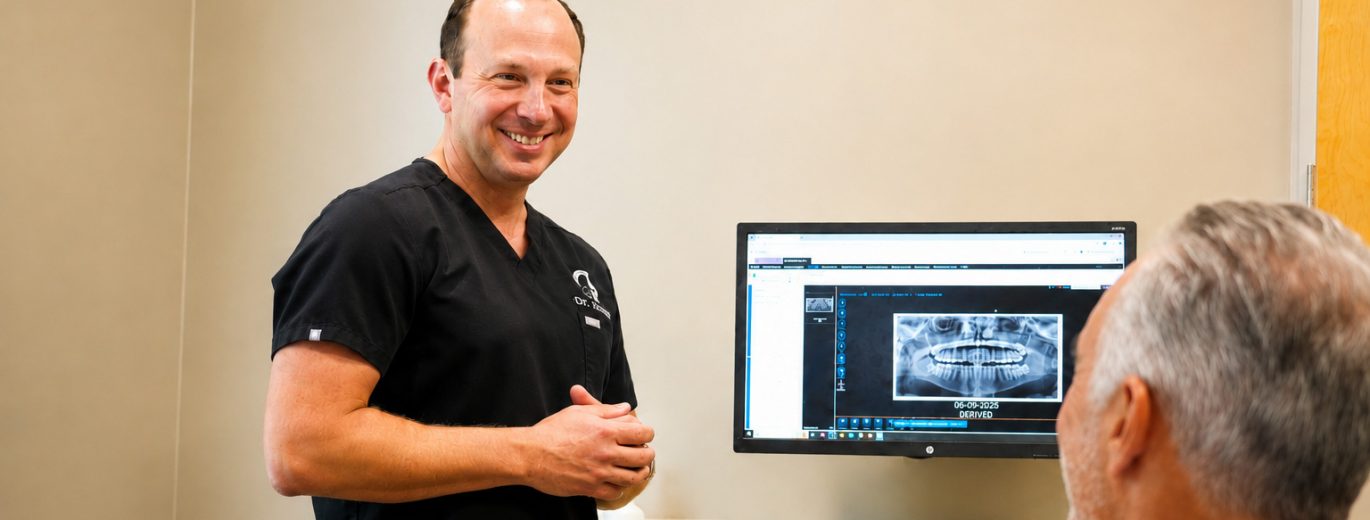
Your oral surgeon evaluates your oral health and uses advanced 3D imaging to examine your jawbone and plan potential implant placement. This appointment is also an opportunity to discuss your goals, medical and dental history, treatment options, expected timeline, recovery, and cost.
2. Treatment planning
If All-on-4® is appropriate for you, your surgical team develops a treatment plan based on your anatomy and oral health.
Your surgeon will also explain what to expect during the procedure and discuss available anesthesia or sedation options. At First Coast Oral Surgery, we offer IV sedation for patients when appropriate.
3. Implant placement
During the procedure, four titanium implants are placed in the jaw to support the new arch of teeth.
With All-on-4®, many patients are able to leave with a fixed set of teeth rather than a removable denture. Whether that is possible depends on your individual case, and your surgeon will talk you through what to expect before the procedure.
Because every patient is different, the surgical and restorative plan can vary. Your surgeon will explain each step based on your anatomy, oral health, and treatment needs.
4. Healing and integration
After implant placement, the implants need time to integrate with the surrounding bone. This process, known as osseointegration, generally takes approximately three to six months. Following your surgeon’s instructions and attending recommended follow-up appointments are important parts of the healing process.
5. Your restoration
Once healing and integration have progressed appropriately, your restorative treatment continues according to your individual plan.
Your oral surgeon and restorative dentist will explain how this stage works and what you can expect from your final teeth.
Who May Be a Good Candidate for All-on-4®?
All-on-4® may be worth considering if you:
- Are missing most or all of the teeth in one arch
- Have multiple failing teeth
- Currently wear removable dentures and want to explore a fixed alternative
- Have experienced some bone loss
- Want to replace a full arch without using an individual implant for every tooth
Your surgeon must evaluate your oral health, jawbone, medical history, medications, and treatment goals before recommending the right approach.
What Do We Evaluate Before Recommending Dental Implants?
Your consultation is a chance for your surgeon to understand what is going on with your teeth, what you hope to change, and what your jaw can support.
Using advanced 3D imaging, we can evaluate your bone structure and potential implant locations. We will also review your medical history and medications, since they can affect treatment planning and healing.
All-on-4® may be an option, but it isn’t right for everyone. Depending on your needs, your surgeon may recommend a different implant approach, bone grafting, or another way to replace missing teeth.
The goal is to find the treatment that makes the most sense for you.
All-on-4® Compared With Traditional Dentures
For many patients, the biggest difference between All-on-4® and traditional dentures is how they feel and function day to day.
Traditional dentures rest on the gums and are removable, so they may require adhesives and can sometimes shift while eating or speaking. All-on-4® is supported by implants placed in the jaw, which means the replacement teeth stay fixed in place instead of sitting on the gums.
That difference in support also affects the jawbone. Dental implants stimulate the bone, while traditional dentures do not.
For a more detailed comparison, you can read our guide to dental implants vs. dentures.
All-on-4® Compared With Traditional Full-Arch Implant Treatment
All-on-4® takes a different approach to replacing a full arch of teeth: instead of using an implant for each missing tooth, it uses four implants to support the entire arch.
Because fewer implants are needed, treatment may also be more affordable than traditional full-arch approaches that use eight or more implants. Still, the right option depends on factors such as how many teeth need to be replaced, how much bone is available, and your individual goals.
A 3D scan and consultation with an oral surgeon can help determine which approach makes the most sense for you.
What Is Recovery Like?
Recovery looks a little different for everyone, so your surgeon will give you instructions based on your specific procedure and needs. That may include guidance on what to eat, how to keep the area clean, medications, activity, and follow-up visits.
Over the next three to six months, the implants gradually integrate with the jawbone. During that time, we will check your progress and let you know when you are ready for the next stage of treatment.
The most important thing is to follow the plan your surgical team gives you, since healing can vary from one patient to another. If anything concerns you during recovery, call our office rather than waiting for your next scheduled visit.
What About Cost and Insurance?
The cost of full-arch dental implants can vary from one patient to another. It depends on things like the number of implants needed, your bone structure, the type of restoration, imaging, and sedation.
During your consultation, our team will walk you through the expected cost, review your dental insurance coverage, and explain any available financing options.
Flexible payment options are available. You can explore payment options to see what fits your situation.
Questions We Hear About All-on-4®
- Can I get teeth the same day? Sometimes, but not for everyone. All-on-4® is designed so that a fixed set of teeth can be attached at the same appointment as your implants. Whether that happens in your case depends on how securely the implants seat in the bone, which your surgeon assesses during the procedure. Your surgeon will review your 3D imaging beforehand and explain what you can expect.
- Do I still need regular dental care after getting implants? Yes. Your implants still need regular care to keep the surrounding gums and bone healthy. We will show you how to clean around your restoration and let you know how often you should come back for checkups and maintenance.
- Can I get All-on-4® on only one arch? Yes. All-on-4® can be used for the upper arch, the lower arch, or both. Which option makes sense for you depends on the condition of your teeth and what you are hoping to address.
- How long do dental implants last? Dental implants are designed to be a long-term solution. How long they last can depend on your oral hygiene, overall health, and regular dental care.
Talk With an Oral Surgeon in Jacksonville or Northeast Florida
If you are missing most or all of your teeth, have multiple failing teeth, or want an alternative to removable dentures, an implant consultation can help you understand your options.
At First Coast Oral Surgery, our board-certified oral surgeons use advanced 3D imaging to evaluate your jaw and develop a treatment plan based on your individual needs.
We see patients at five locations across Northeast Florida: Jacksonville, Amelia Island, Orange Park, Lake City, and Palm Coast.
Request an appointment to find out whether All-on-4® or another dental implant option may be right for you, or contact us if you have a question first.
This article is for general information only and is not a substitute for an evaluation by a qualified provider. Whether All-on-4® or any other treatment is appropriate for you can only be determined by an in-person examination and imaging.